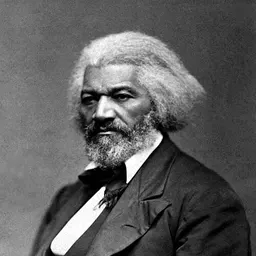
Frederick Douglass
Abolitionist, writer and orator · 1818–1895
Douglass escaped slavery and became one of the leading voices of the abolitionist movement through his speeches, newspapers and autobiographies. After the Civil War he served in federal posts and advocated civil and voting rights for Black Americans and women.
How close are you? Take the test →Position on the 12 axes
Estimated from their documented words and actions. A simplification, not a verdict.
He backed strong federal power to end slavery and enforce Reconstruction against Southern states.
He campaigned for the vote for freedmen, culminating in the Fifteenth Amendment, and for women.
He defended free speech and personal liberty against slavery laws such as the Fugitive Slave Act.
He lectured across Britain and Ireland and served as US minister to Haiti.
He urged Lincoln to wage the Civil War against slavery and recruited Black soldiers for the Union army.
His 'Composite Nation' speech argued for welcoming immigrants of all origins.
He stressed self-reliance and free labour, though he also supported some land for freed people.
He favoured federal aid to freed people but largely accepted the free-labour economy of his era.
No strong recorded view on trade beyond his general support for the Republican Party.
He condemned slaveholding Christianity yet remained a believer and drew heavily on biblical language.
By the standards of his time he was strongly progressive, endorsing women's suffrage at Seneca Falls in 1848.
He welcomed modern progress and was an enthusiast of photography as a tool for equality.