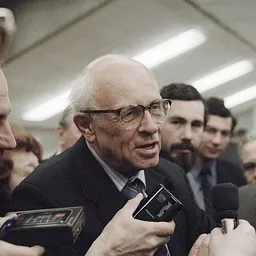
Andrei Sakharov
Nuclear physicist and human rights activist · 1921–1989
Sakharov was a Soviet physicist who helped develop the hydrogen bomb and later became the country's best-known dissident and human-rights campaigner. He was awarded the Nobel Peace Prize in 1975 and exiled to Gorky from 1980 to 1986.
How close are you? Take the test →Position on the 12 axes
Estimated from their documented words and actions. A simplification, not a verdict.
His draft constitution proposed a voluntary union of equal republics with the right to secede.
He campaigned for free elections and ended his life as an elected member of the Congress of People's Deputies.
He defended political prisoners and freedom of speech, emigration and conscience.
He argued for the convergence of socialist and capitalist systems and global cooperation.
He built nuclear weapons but later campaigned against testing and the arms race.
He defended the rights of minorities, including Crimean Tatars, and the right to emigrate.
His convergence theory blended socialist welfare with market elements.
He criticised rigid Soviet planning while supporting a mixed economy.
He favoured open exchange of ideas and goods between East and West.
He was not religious and grounded his views in reason and human rights.
He promoted human rights and openness in Soviet society.
He supported scientific progress, including nuclear power, as necessary for humanity.