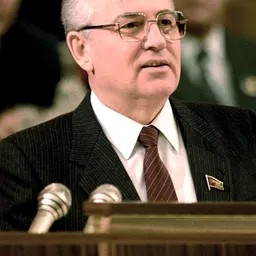
Mikhail Gorbachev
Last leader of the Soviet Union · 1931–2022
Gorbachev led the Soviet Union from 1985 to 1991. His policies of glasnost and perestroika opened up political debate and the economy, helped end the Cold War and preceded the collapse of the Soviet Union.
How close are you? Take the test →Position on the 12 axes
Estimated from their documented words and actions. A simplification, not a verdict.
He proposed a New Union Treaty giving republics much greater autonomy within a looser federation.
He introduced contested elections to a new Congress of People's Deputies and ended the party's monopoly in 1990.
His glasnost policy relaxed censorship and freed political prisoners, though force was used in the Baltics in 1991.
He promoted "new political thinking," arms control and cooperation with the West.
He signed major arms reduction treaties and withdrew Soviet troops from Afghanistan.
No strong recorded view on immigration; he struggled with rising nationalist movements in the republics.
He remained a socialist who sought to reform rather than abolish public ownership.
His perestroika allowed cooperatives and some market mechanisms within a planned economy.
He allowed joint ventures and greater foreign trade.
He eased restrictions on religion and allowed the 1988 celebration of the millennium of Russian Christianity.
He supported political liberalisation and greater openness in society.
He sought to modernise Soviet technology through "acceleration" (uskoreniye).