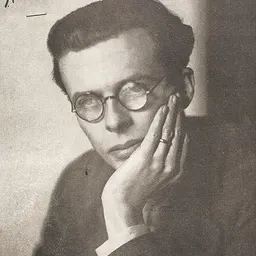
Aldous Huxley
Novelist and essayist · 1894–1963
Huxley was an English writer best known for Brave New World, which depicts a society controlled through conditioning and pleasure. He was a committed pacifist in the 1930s, explored mysticism and psychedelics, and warned about technological and centralised control.
How close are you? Take the test →Position on the 12 axes
Estimated from their documented words and actions. A simplification, not a verdict.
In his later foreword to Brave New World and in Island he favoured decentralised, cooperative communities.
He warned that propaganda and conditioning threatened democratic self-government.
Brave New World Revisited warned of state manipulation that would erode personal freedom.
He backed international pacifist movements and world cooperation.
He was a sponsor of the Peace Pledge Union and opposed rearmament in the 1930s.
No strong recorded view on immigration.
He favoured cooperative economics but was wary of both capitalism and state socialism.
He opposed centralised planning and argued for small-scale cooperative enterprise.
No strong recorded view on trade.
His perennial philosophy drew on mysticism, but he did not seek to bring religion into law.
He experimented with psychedelics and liberal values, though he had earlier sympathised with eugenics.
He warned that technology could be used to control people, while hoping science could serve human ends.