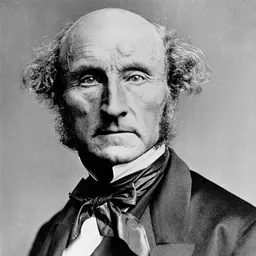
John Stuart Mill
English philosopher and Liberal MP · 1806–1873
John Stuart Mill was an English philosopher, economist and member of Parliament who wrote On Liberty and The Subjection of Women. He defended individual freedom under the harm principle and campaigned for women's suffrage and representative government.
How close are you? Take the test →Position on the 12 axes
Estimated from their documented words and actions. A simplification, not a verdict.
Supported strong local self-government as a school of civic participation.
Championed representative government and universal suffrage, though he proposed extra votes for the educated.
His harm principle limits state power to preventing harm to others.
Argued against intervention among civilised nations, while defending British rule in India.
Opposed aggressive war but accepted intervention in some cases.
Argued in Considerations on Representative Government that free institutions work best with a shared nationality.
Grew sympathetic to cooperatives and socialism in later editions of his economics.
Held laissez-faire as the general rule while accepting many exceptions.
Supported free trade, allowing a temporary infant-industry exception.
Wrote critically of religion and defended freedom of thought against religious orthodoxy.
Introduced a women's suffrage amendment in Parliament and argued for equality between the sexes.
Supported scientific and economic progress while valuing a future 'stationary state'.