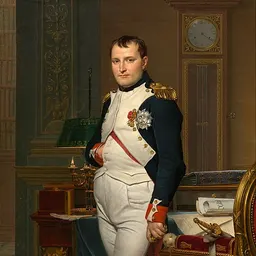
Napoleon Bonaparte
Emperor of the French · 1769–1821
Napoleon rose through the revolutionary army, seized power in 1799 and crowned himself Emperor of the French in 1804. He conquered much of Europe, introduced the Napoleonic Code, and was finally defeated at Waterloo in 1815.
How close are you? Take the test →Position on the 12 axes
Estimated from their documented words and actions. A simplification, not a verdict.
Created a highly centralised administration run by prefects appointed from Paris.
Took power in a coup and ruled as emperor, using managed plebiscites to legitimise his rule.
Censored the press, built a large police network and suppressed opposition.
Reorganised Europe under French domination through client states and family rulers.
Fought near-continuous wars across Europe and built his rule on military conquest.
Granted Jews civil rights in return for adopting French law and customs through the Grand Sanhedrin.
The Napoleonic Code entrenched private property and contract rights.
Founded the Banque de France and directed the economy toward state and war needs.
His Continental System banned trade with Britain across the European continent.
Signed the Concordat restoring Catholic worship under state control, using religion as a tool of order.
Spread legal equality and ended feudal privileges, but restored slavery in French colonies in 1802.
Promoted engineering, the metric system and science, including the scholarly expedition to Egypt.