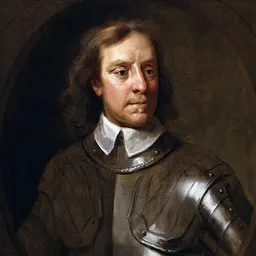
Oliver Cromwell
Lord Protector of England, Scotland and Ireland · 1599–1658
Cromwell was a Puritan MP and general who led Parliament's forces to victory in the English Civil War and signed the death warrant of Charles I. He ruled the Commonwealth as Lord Protector from 1653, conquering Ireland and Scotland with great loss of life.
How close are you? Take the test →Position on the 12 axes
Estimated from their documented words and actions. A simplification, not a verdict.
Unified England, Scotland and Ireland under one Commonwealth government and divided England among Major-Generals.
Fought for Parliament but forcibly dissolved parliaments and ruled as Lord Protector backed by the army.
Used the army to enforce order and moral regulation through the rule of the Major-Generals.
Pursued English national and Protestant interests through wars with the Dutch and Spain.
Built the New Model Army and conducted the conquests of Ireland and Scotland, including the sieges of Drogheda and Wexford.
Allowed Jews to resettle in England in 1656, while Catholic land in Ireland was confiscated for Protestant settlers.
At the Putney Debates he defended property qualifications for voting against the Levellers.
No strong recorded view on economic management beyond mercantilist policies of the time.
The Commonwealth's Navigation Act 1651 restricted trade to English ships, leading to war with the Dutch.
Saw himself as an instrument of Providence and governed according to Puritan religious aims.
By 17th-century standards tolerant of Protestant sects, but imposed Puritan moral codes and suppressed Catholicism.
No strong recorded view on technology.