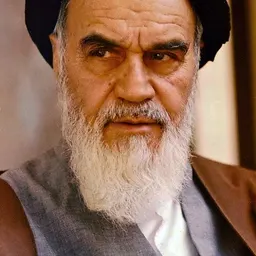
Ruhollah Khomeini
Supreme Leader of Iran · 1902–1989
Khomeini was a Shia cleric who led the 1979 Iranian Revolution and became the first Supreme Leader of the Islamic Republic of Iran. He developed the doctrine of guardianship of the Islamic jurist, giving senior clergy final authority over the state.
How close are you? Take the test →Position on the 12 axes
Estimated from their documented words and actions. A simplification, not a verdict.
He built a centralised Islamic state under the authority of the Supreme Leader.
The Islamic Republic held elections, but unelected clerical bodies vetted candidates and he held final authority.
His government executed thousands of political prisoners, notably in 1988, and imposed strict public morality laws.
He called for exporting the Islamic revolution and pan-Islamic unity under the slogan "neither East nor West."
He continued the Iran-Iraq War for years, only agreeing to a ceasefire in 1988.
He imposed a single Islamic identity on public life, while recognising certain religious minorities.
He championed the "mostazafin," the oppressed, and his government nationalised banks and major industries.
The new state took over much of the economy through nationalisation and religious foundations.
He rejected economic dependence on the West, favouring self-sufficiency.
He made Islamic law the basis of the state under clerical rule.
He enforced compulsory veiling and religious law on family and morality.
He accepted modern media and technology but subordinated them to Islamic values.