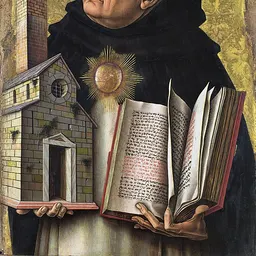
Thomas Aquinas
Dominican friar, theologian and philosopher · 1225–1274
Thomas Aquinas was a medieval theologian who combined Aristotle's philosophy with Christian doctrine in works such as the Summa Theologiae. His political thought set out natural law, just war theory and the view that rulers must govern for the common good under divine law.
How close are you? Take the test →Position on the 12 axes
Estimated from their documented words and actions. A simplification, not a verdict.
No strong recorded view on central versus local power; he wrote of a single ruler governing a kingdom or city.
Thought monarchy the best form of rule but recommended a mixed constitution in which the people choose and share in government.
Held that law should direct people toward the common good and that obstinate heretics could be handed over for execution.
Saw all peoples as bound by one natural law and one universal Church, above particular kingdoms.
Set out the conditions for a just war: legitimate authority, a just cause and right intention.
No strong recorded view on immigration or cultural integration.
Defended private property but taught that surplus wealth is owed to the poor and that taking in dire need is not theft.
Supported the idea of a just price and condemned lending at interest, accepting moral limits on trade.
No strong recorded view on trade between nations.
A Catholic theologian who placed divine law and Church teaching at the base of political order.
Defended the established religious and social hierarchy of 13th-century Christendom.
By medieval standards he embraced reason and Aristotle's natural science, but held it subordinate to faith; no view on technology as such.