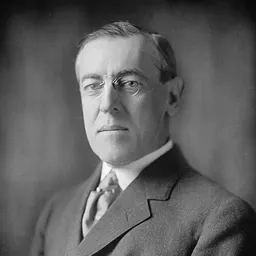
Woodrow Wilson
28th President of the United States · 1856–1924
Wilson, a Democrat and former Princeton president, created the Federal Reserve and led the United States into the First World War. His Fourteen Points and League of Nations plan shaped liberal internationalism, while at home he oversaw wartime repression and segregation of the federal civil service.
How close are you? Take the test →Position on the 12 axes
Estimated from their documented words and actions. A simplification, not a verdict.
Expanded federal power through the Federal Reserve, the income tax and wartime economic agencies.
Spoke of making the world safe for democracy but restricted dissent and segregated federal offices.
Signed the Espionage and Sedition Acts, under which critics of the war were imprisoned.
His Fourteen Points and campaign for the League of Nations made him a defining internationalist.
Campaigned on staying out of war, then entered the First World War and sent troops into Mexico, Haiti and the Dominican Republic.
Vetoed literacy tests for immigrants but denounced hyphenated Americans whose loyalty he questioned.
His New Freedom program attacked monopolies and introduced a progressive income tax within a market system.
Created the Federal Reserve and Federal Trade Commission, and the War Industries Board directed wartime production.
Signed the Underwood Tariff cutting duties and called for removing trade barriers in the Fourteen Points.
A devout Presbyterian whose politics were framed in strongly moral and religious terms.
Enacted economic reforms and eventually backed women's suffrage, but resegregated the federal workforce.
No strong recorded view on technology beyond ordinary support for modernisation.