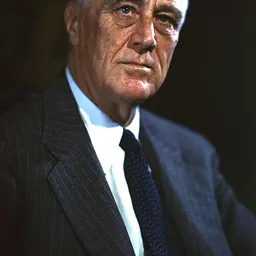
Franklin D. Roosevelt
32nd President of the United States · 1882–1945
Roosevelt served four terms as president, answering the Great Depression with the New Deal and leading the United States through most of the Second World War. He greatly enlarged the federal government's economic role and laid the groundwork for the United Nations.
How close are you? Take the test →Position on the 12 axes
Estimated from their documented words and actions. A simplification, not a verdict.
The New Deal moved economic and social policy decisively from the states to Washington.
Won four elections but tried to enlarge the Supreme Court to overcome rulings against his program.
Ordered the internment of over 100,000 Japanese Americans under Executive Order 9066.
Shaped the Atlantic Charter, Bretton Woods and the United Nations as frameworks for global cooperation.
Built the arsenal of democracy and led the war against the Axis powers.
Kept restrictive immigration quotas in place, including for Jewish refugees in the 1930s.
Created Social Security and raised top tax rates, while aiming to save rather than replace capitalism.
The New Deal brought extensive regulation, public works and agencies directing the economy.
His Reciprocal Trade Agreements Act of 1934 began lowering U.S. tariffs.
An Episcopalian who used religious language publicly, notably in his D-Day prayer.
Expanded labour and social rights, though New Deal programs largely accepted Southern racial segregation.
Backed the Tennessee Valley Authority, rural electrification and the Manhattan Project.