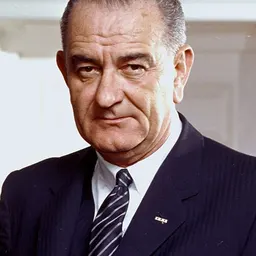
Lyndon B. Johnson
36th President of the United States · 1908–1973
Johnson became president after Kennedy's assassination and pushed through the Civil Rights Act, the Voting Rights Act, and the Great Society programs. His escalation of the Vietnam War divided the country and led him not to seek re-election in 1968.
How close are you? Take the test →Position on the 12 axes
Estimated from their documented words and actions. A simplification, not a verdict.
Used federal law and spending to override Southern states on civil rights and to fund national programs.
Signed the Voting Rights Act of 1965, while his administration misled the public about Vietnam.
Expanded FBI and CIA surveillance of anti-war and civil rights activists.
Worked through Cold War alliances but treated Vietnam chiefly as a matter of U.S. credibility.
Escalated the Vietnam War to over half a million U.S. troops after the Gulf of Tonkin Resolution.
Signed the 1965 Immigration and Nationality Act, abolishing national-origin quotas.
Declared a War on Poverty and created Medicare, Medicaid and federal aid to schools.
The Great Society greatly expanded federal programs and regulation of social and economic life.
Oversaw completion of the Kennedy Round of multilateral tariff reductions.
A member of the Disciples of Christ; no strong recorded view on religion in public life.
Passed the Civil Rights Act of 1964, ending legal segregation in public accommodations.
A long-time champion of NASA who drove the space program through the Apollo era.