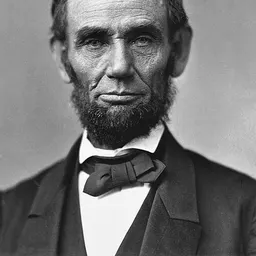
Abraham Lincoln
16th President of the United States · 1809–1865
Lincoln led the United States through the Civil War, preserving the Union against secession. A former Whig and early Republican, he issued the Emancipation Proclamation and pushed the Thirteenth Amendment abolishing slavery.
How close are you? Take the test →Position on the 12 axes
Estimated from their documented words and actions. A simplification, not a verdict.
Denied any state right to secede and used federal power to hold the Union together.
Defined democracy as government of, by and for the people and held the 1864 election during wartime.
Suspended habeas corpus and allowed military arrests of civilians during the Civil War.
Focused on domestic union; his foreign policy aimed mainly at keeping Britain and France out of the war.
Opposed the Mexican War as a congressman but prosecuted the Civil War to total victory as president.
Publicly rejected the anti-immigrant Know-Nothings and signed the 1864 Act to Encourage Immigration.
Championed free labour and the Homestead Act, giving land to settlers, within a market economy.
A Whig on economics, he backed railroads, internal improvements, national banking and land-grant colleges.
Supported high protective tariffs, including the Morrill Tariff, throughout his career.
Never joined a church yet used biblical language heavily; no strong view on religion in law.
By 19th-century standards strongly reformist: he ended slavery, though he held some views on race common to his era.
The only president to hold a patent; he backed the transcontinental railroad and founded the National Academy of Sciences.