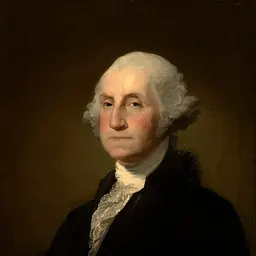
George Washington
1st President of the United States · 1732–1799
Washington commanded the Continental Army in the American Revolution and presided over the Constitutional Convention before serving two terms as the first president. He backed a stronger national government than the Articles of Confederation allowed, kept the country neutral abroad, and set the precedent of leaving office voluntarily.
How close are you? Take the test →Position on the 12 axes
Estimated from their documented words and actions. A simplification, not a verdict.
Pushed to replace the weak Articles of Confederation with a stronger national government and sided with the Federalists in office.
Stepped down after two terms and accepted civilian authority, though the electorate of his day was limited to propertied white men.
Led militia in person to put down the Whiskey Rebellion, asserting federal authority over tax resisters.
His Farewell Address warned against permanent alliances and foreign entanglements, and he proclaimed neutrality in the French wars.
A career soldier and wartime commander who still favoured a small standing army and avoided new wars as president.
Welcomed immigrants but wrote that they should be absorbed into American customs and laws rather than settle as separate communities.
A wealthy planter and enslaver who defended property rights; he arranged in his will for the people he enslaved to be freed.
Backed Hamilton's national bank and debt assumption, an active federal role in finance for its time.
Signed the Tariff of 1789 and encouraged domestic manufactures, partly to reduce dependence on Britain.
Attended Anglican services and spoke of Providence, but stressed religious liberty and avoided sectarian language.
By 18th-century standards a moderate: he led a republican revolution yet held people in slavery throughout his life.
Experimented with new farming methods and signed the first U.S. Patent Act in 1790.