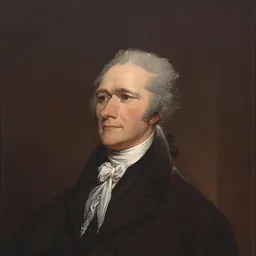
Alexander Hamilton
1st United States Secretary of the Treasury · 1755–1804
Hamilton co-wrote The Federalist Papers and, as the first Treasury Secretary, built the young republic's financial system. He argued for a strong central government, public credit, a national bank, and state support for manufacturing.
How close are you? Take the test →Position on the 12 axes
Estimated from their documented words and actions. A simplification, not a verdict.
Argued for an energetic national government and federal assumption of state debts at the expense of state power.
Proposed an executive and senate serving for life at the Constitutional Convention and distrusted popular majorities.
Supported forceful suppression of the Whiskey Rebellion and backed the Federalist Alien and Sedition Acts.
Favoured close commercial ties with Britain and defended the Jay Treaty, while putting national economic strength first.
Served as inspector general of an enlarged army during the Quasi-War and favoured a strong military establishment.
Though an immigrant himself, he opposed easing naturalization in 1802 and worried about foreigners' political influence.
Tied the interests of wealthy creditors to the state and defended property and commerce.
His Report on Manufactures called for bounties, a national bank and active federal economic development.
Recommended protective tariffs and subsidies to build American industry against British competition.
Largely secular in early life but became more devout later and proposed a Christian Constitutional Society.
Co-founded the New York Manumission Society against slavery, while holding elitist views of government.
Envisioned an industrial, commercial America built on manufacturing and new production methods.