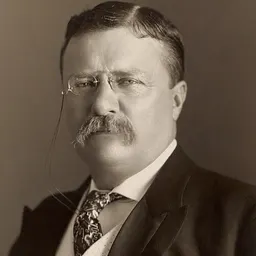
Theodore Roosevelt
26th President of the United States · 1858–1919
Roosevelt became president in 1901 and led the Progressive Era push to regulate big business and conserve public land. He expanded American power abroad with a large navy and the Panama Canal, and later ran on the Progressive Party's New Nationalism platform.
How close are you? Take the test →Position on the 12 axes
Estimated from their documented words and actions. A simplification, not a verdict.
His New Nationalism called for a strong federal government to regulate business and protect the public interest.
Backed direct primaries and popular reforms while holding an expansive view of executive power.
Favoured order and vigorous law enforcement, from his time as New York police commissioner onward.
Pursued American great-power interests, though he mediated the Russo-Japanese War and later endorsed a league of nations.
Built the Great White Fleet, fought with the Rough Riders and summed up his approach as the big stick.
Demanded full Americanization of immigrants, attacked hyphenated Americanism and limited Japanese immigration.
His Square Deal curbed trusts and protected workers, but he defended private enterprise against socialism.
Expanded federal regulation through the Pure Food and Drug Act, railroad rate laws and national conservation.
Accepted the Republican protective tariff, though he treated tariff reform as a secondary issue.
A practising Dutch Reformed Christian who still objected to putting In God We Trust on coins.
Supported women's suffrage and labour reforms in 1912, alongside views on race and empire common in his era.
Promoted the Panama Canal and a modern navy while also championing conservation of nature.