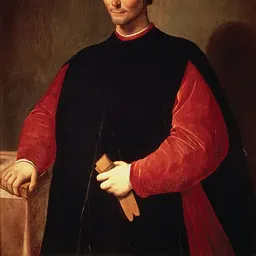
Niccolò Machiavelli
Florentine diplomat and political theorist · 1469–1527
Niccolò Machiavelli was a Florentine civil servant and diplomat who wrote The Prince and the Discourses on Livy. He analysed how power is gained and kept, separating politics from conventional morality, and favoured republics with citizen armies while advising princes on effective rule.
How close are you? Take the test →Position on the 12 axes
Estimated from their documented words and actions. A simplification, not a verdict.
Implied view: called for a strong leader to unite a divided Italy, while admiring Rome's republican institutions.
The Discourses favour mixed republics, but The Prince, his best-known work, advises autocrats on keeping power.
Argued rulers must be willing to use force and fear to preserve the state's order and stability.
The Prince closes with a patriotic call to free Italy from foreign 'barbarians'.
Wrote The Art of War, urged citizen militias over mercenaries and said a prince should study war above all.
No strong recorded view; he discussed planting colonies in conquered lands as a tool of control.
In the Discourses he held that well-ordered republics keep the state rich and citizens relatively poor.
No strong recorded view; pre-modern thought offers no direct equivalent.
No strong recorded view; pre-modern thought offers no direct equivalent.
Treated religion as a tool of statecraft and blamed the papacy for keeping Italy divided.
No direct equivalent; looked to ancient Rome as a model while breaking with conventional moral teaching.
No strong recorded view; pre-modern thought offers no direct equivalent.