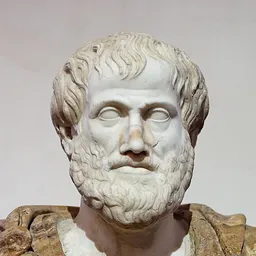
Aristotle
Greek philosopher, author of the Politics · 384–322 BC
Aristotle was a Greek philosopher who studied under Plato and tutored Alexander the Great. His Politics surveyed many constitutions and favoured a mixed 'polity' run by a broad middle class within a small, self-sufficient city-state.
How close are you? Take the test →Position on the 12 axes
Estimated from their documented words and actions. A simplification, not a verdict.
Implied view: valued the small, self-governing polis as the natural political unit; no view on federations of cities.
Favoured a mixed 'polity' blending democratic and oligarchic elements, and criticised pure democracy and tyranny alike.
Held that law and public education should shape citizens' character and habits toward virtue.
Treated the Greek city as the full community and regarded non-Greeks as naturally suited to be ruled.
Argued war is justified only for the sake of peace, while expecting citizens to be trained for defence.
Restricted citizenship tightly and argued that 'barbarians' were natural slaves, implying a closed civic community.
Defended private property against Plato's communism, while favouring shared use and a strong middle class.
Implied view: expected the city to regulate economic life and criticised unlimited money-making.
Valued the city's self-sufficiency and was suspicious of retail trade and commerce for profit.
Expected the city to maintain public cults and priesthoods, while his own ethics rested on reason rather than revelation.
Defended natural slavery and the rule of husbands over wives as part of a natural hierarchy.
No strong recorded view; pre-modern thought offers no direct equivalent.