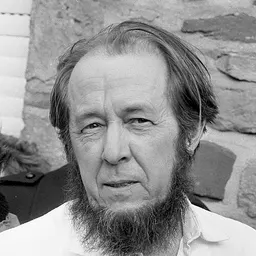
Aleksandr Solzhenitsyn
Novelist and Soviet dissident · 1918–2008
Solzhenitsyn was a Russian writer who exposed the Soviet labour-camp system in works such as One Day in the Life of Ivan Denisovich and The Gulag Archipelago. Expelled from the USSR in 1974, he criticised both communism and Western materialism and promoted a Russian Orthodox national revival.
How close are you? Take the test →Position on the 12 axes
Estimated from their documented words and actions. A simplification, not a verdict.
In Rebuilding Russia he proposed local self-government based on the old zemstvo councils.
He favoured gradual, local democracy and was sceptical of Western-style party politics.
He fought Soviet censorship, yet favoured a strong moral order over unrestricted liberal freedom.
He was a Russian nationalist who stressed national and spiritual identity.
He urged Russia to give up its empire but defended a strong Russian state.
He emphasised preserving Russian language, culture and Orthodox tradition.
He rejected communism and collectivisation and favoured small private property.
He condemned Soviet central planning but also criticised unregulated Western capitalism.
No strong recorded view on trade, though he opposed Russia's sale of resources to foreign interests.
He saw Orthodox Christianity as the foundation for Russia's moral renewal.
His 1978 Harvard address criticised Western secularism and moral decline.
He warned that technological progress and materialism had eroded spiritual life.