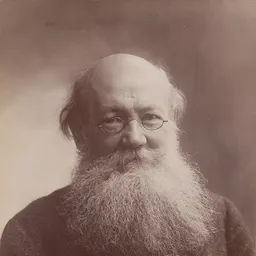
Peter Kropotkin
Anarchist theorist and geographer · 1842–1921
Kropotkin was a Russian prince turned anarchist who developed the theory of anarcho-communism in works such as The Conquest of Bread and Mutual Aid. He argued that cooperation was a driving force in evolution and that society could be organised through free federations of communes.
How close are you? Take the test →Position on the 12 axes
Estimated from their documented words and actions. A simplification, not a verdict.
He envisioned society as a free federation of self-governing communes and workers' associations.
He rejected representative government as well as dictatorship, favouring direct communal self-management.
He opposed prisons, police and state coercion, writing on the failure of punishment.
He was an internationalist anarchist, though he controversially backed the Allies in the First World War.
He signed the Manifesto of the Sixteen supporting the Allied war effort, splitting with anti-war anarchists.
No strong recorded view on immigration or cultural integration.
He called for distribution according to need and the common ownership of land and production.
He rejected state planning in favour of voluntary cooperation between communes.
No strong recorded view on trade policy.
He was a materialist and atheist who grounded ethics in natural cooperation rather than religion.
He supported the emancipation of women and the dismantling of traditional hierarchies.
In Fields, Factories and Workshops he praised intensive, scientific agriculture and decentralised modern industry.