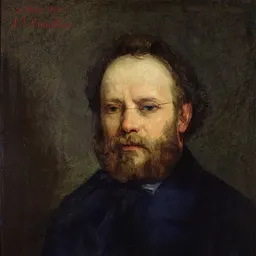
Pierre-Joseph Proudhon
Socialist writer and first self-described anarchist · 1809–1865
Proudhon was a French writer who declared that 'property is theft' and was the first to call himself an anarchist. He developed mutualism, a system of cooperative exchange and free credit, and later argued for political federalism.
How close are you? Take the test →Position on the 12 axes
Estimated from their documented words and actions. A simplification, not a verdict.
In The Principle of Federation he argued for power divided among small self-governing units.
He sat in the National Assembly in 1848 but was sceptical that universal suffrage produced real self-rule.
He opposed state authority and was imprisoned for attacking Louis-Napoleon Bonaparte in print.
He opposed large unified nation-states such as a centralised Italy, favouring federations instead.
His work War and Peace treated war ambivalently as both a historical force and a scourge.
No clear view on immigration; his private notebooks contain antisemitic remarks.
He attacked property income as theft but defended small personal possession by workers and peasants.
His mutualist plans, such as a People's Bank, relied on voluntary exchange rather than the state.
No strong recorded view on trade.
He was strongly anticlerical and hostile to the Church's role in public life.
He held conservative views on family and opposed women's emancipation, unlike many fellow socialists.
No strong recorded view on technology.