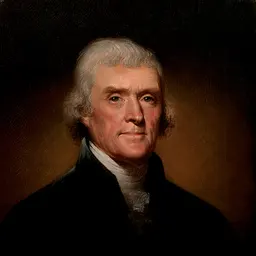
Thomas Jefferson
3rd President of the United States · 1743–1826
Jefferson drafted the Declaration of Independence and led the Democratic-Republican Party as the third president. He championed states' rights, agrarian self-government, and religious freedom, while owning hundreds of enslaved people.
How close are you? Take the test →Position on the 12 axes
Estimated from their documented words and actions. A simplification, not a verdict.
Wrote the Kentucky Resolutions asserting states' power to resist federal overreach and opposed Hamilton's centralising program.
Argued that government rests on the consent of the governed and favoured broad white male suffrage, while excluding enslaved people.
Opposed the Alien and Sedition Acts and pressed for a Bill of Rights; his Embargo Act enforcement was a notable exception.
Warned against entangling alliances and kept the U.S. out of the Napoleonic Wars through the embargo.
Cut the army and navy and preferred economic pressure to war, though he fought the Barbary pirates.
Doubted mass immigration from monarchies in Notes on Virginia but later supported easier naturalization.
Idealised independent small farmers and distrusted concentrated finance, while defending private property, including in people.
Opposed the national bank and favoured a frugal federal government with minimal economic intervention.
Favoured free commerce in principle but used a sweeping trade embargo against Britain and France in 1807.
Wrote the Virginia Statute for Religious Freedom and described a wall of separation between church and state.
Progressive by 18th-century standards on liberty and education, yet he held people in slavery and opposed racial equality.
An inventor and naturalist who promoted science, agricultural improvement and the patent system.