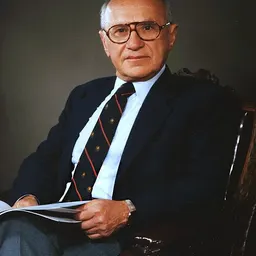
Milton Friedman
American economist and Nobel laureate · 1912–2006
Milton Friedman was an American economist and Nobel laureate who led the Chicago School of economics. He advocated monetarism, free markets, floating exchange rates and school vouchers, and influenced conservative governments in the US and UK.
How close are you? Take the test →Position on the 12 axes
Estimated from their documented words and actions. A simplification, not a verdict.
Favoured decentralising government power to states and localities.
Supported democratic government, while arguing economic freedom is a precondition for political freedom.
Argued for limiting state power over individual choices.
Supported international trade but opposed fixed exchange-rate systems.
Helped end the US military draft while supporting national defence.
Argued that free immigration is incompatible with a generous welfare state.
Defended private enterprise and market outcomes.
Favoured minimal government, with a negative income tax to replace welfare programmes.
Supported free trade, including unilateral tariff removal.
Held secular views and kept religion out of his public advocacy.
Supported ending drug prohibition and the military draft.
Saw market-driven technological change as beneficial.