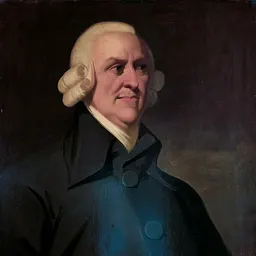
Adam Smith
Scottish economist and moral philosopher · 1723–1790
Adam Smith was a Scottish moral philosopher whose The Wealth of Nations argued that the division of labour and free exchange create national prosperity. He criticised mercantilist monopolies and trade restrictions while assigning the state duties of defence, justice and public works.
How close are you? Take the test →Position on the 12 axes
Estimated from their documented words and actions. A simplification, not a verdict.
No strong recorded view; proposed American representation in Parliament as an alternative to separation.
Supported Britain's constitutional monarchy and wrote little directly on suffrage.
Advocated a 'system of natural liberty' with limited state interference in individual affairs.
Saw trade as binding nations together and criticised colonial monopolies.
Held that 'defence is of much more importance than opulence' and defended a standing army.
No strong recorded view.
Defended markets and private property, while sympathising with labourers and criticising collusion by employers.
Opposed most state intervention, but supported public works, education and some regulation.
Attacked mercantilist tariffs and bounties and argued for free trade, with exceptions like the Navigation Acts.
Favoured many competing religious sects over a single established church.
By the standards of his time a reformer who opposed slavery and guild privileges.
Praised the productivity gains of specialisation and improved machinery.