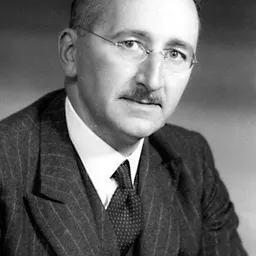
Friedrich Hayek
Austrian-British economist and political philosopher · 1899–1992
Friedrich Hayek was an Austrian-born economist who wrote The Road to Serfdom and shared the 1974 Nobel Memorial Prize in Economics. He argued that central planning threatens freedom and that markets coordinate dispersed knowledge better than governments can.
How close are you? Take the test →Position on the 12 axes
Estimated from their documented words and actions. A simplification, not a verdict.
Favoured decentralised government and proposed an interstate federation to limit national economic power.
Valued limited government above majority rule and made favourable remarks about Pinochet's Chile.
Argued that economic planning leads to the loss of personal freedom.
Backed a federation of states to keep trade open, while opposing global economic planning.
No strong recorded view beyond supporting national defence.
No strong recorded view.
Defended private property and rejected 'social justice' as a meaningless goal.
Opposed central planning but accepted a minimum income and some state services.
Supported free trade and open international markets.
An agnostic who nonetheless saw religion as a carrier of useful traditions.
Defended evolved traditions and rules, though he denied being a conservative.
Supported innovation through competition and the spread of knowledge.