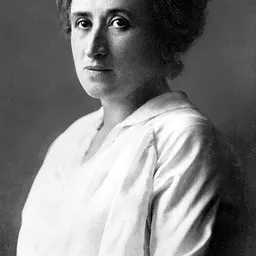
Rosa Luxemburg
Marxist theorist and revolutionary · 1871–1919
Luxemburg was a Polish-born Marxist theorist and leader of the German left who opposed the First World War and co-founded the Spartacus League. She criticised reformist socialism and also the Bolsheviks' suppression of democracy, and was killed by Freikorps troops in 1919.
How close are you? Take the test →Position on the 12 axes
Estimated from their documented words and actions. A simplification, not a verdict.
She opposed national self-determination and regional separatism, favouring a unified workers' movement.
She criticised Lenin's suppression of elections and a free press, while still supporting proletarian revolution.
Her line that freedom is always freedom for those who think differently defended dissent under socialism.
She held that workers had no fatherland and opposed Polish nationalism as a distraction from class struggle.
She opposed the First World War and was imprisoned for anti-militarist agitation.
No strong recorded view on immigration or cultural integration.
She sought the abolition of private ownership of the means of production.
She advocated a socialist economy organised collectively in place of market capitalism.
In The Accumulation of Capital she treated tariffs and imperial expansion as tools of capitalist competition.
As a Marxist she regarded religion as a matter for private conscience and opposed church power.
She supported women's suffrage and broad social emancipation.
She accepted industrial development as the basis for socialism, with no particular view on technology.