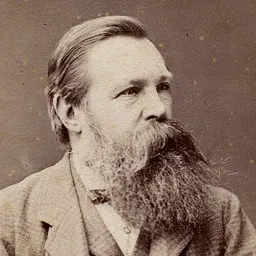
Friedrich Engels
German socialist theorist and co-author of The Communist Manifesto · 1820–1895
Friedrich Engels was a German businessman and socialist theorist who co-wrote The Communist Manifesto with Karl Marx and edited Capital after Marx's death. His own works included studies of working-class conditions in England and the origins of the family and the state.
How close are you? Take the test →Position on the 12 axes
Estimated from their documented words and actions. A simplification, not a verdict.
In his critique of the Erfurt Programme he favoured a single, unitary republic over federalism.
Supported democratic republics but also a transitional dictatorship of the proletariat.
Mixed: aimed at freedom from class rule while defending revolutionary authority.
Co-founded the international socialist movement under the slogan 'workers of the world, unite'.
Wrote widely on military affairs and expected revolution to involve armed struggle.
No strong recorded view on immigration; saw class as more important than nationality.
Called for abolishing private ownership of the means of production.
Envisioned production planned by society as a whole.
Like Marx, treated free trade as speeding capitalism's development rather than as a goal.
A materialist who treated religion as a product of social conditions.
The Origin of the Family linked women's subordination to private property and predicted its end.
Saw industrial technology as laying the material basis for socialism.