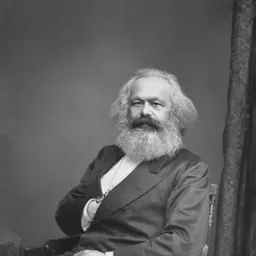
Karl Marx
German philosopher, economist and revolutionary socialist · 1818–1883
Karl Marx was a German philosopher and economist who co-wrote The Communist Manifesto and wrote Capital. He argued that history is driven by class struggle and that capitalism would be replaced by a classless, communist society after a proletarian revolution.
How close are you? Take the test →Position on the 12 axes
Estimated from their documented words and actions. A simplification, not a verdict.
The Manifesto calls for centralising credit and transport in the state, though he praised the Paris Commune's local organisation.
Supported universal suffrage but also a transitional 'dictatorship of the proletariat'.
Mixed: aimed at human emancipation while accepting coercion during revolutionary transition.
Declared that workers have no country and helped found the International Workingmen's Association.
Expected the overthrow of capitalism to require revolutionary force in most countries.
No strong recorded view on immigration; treated national divisions as secondary to class.
Called for abolishing private ownership of the means of production.
Envisioned production organised under common social control.
In 1848 he backed free trade because it would hasten capitalism's crisis.
Called religion 'the opium of the people' and expected it to disappear.
Sought the overthrow of existing social hierarchies, including bourgeois family structures.
Saw development of productive forces and technology as the engine of historical progress.