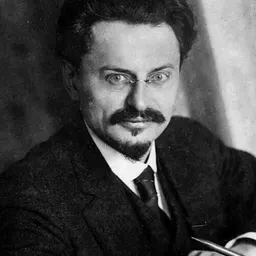
Leon Trotsky
Bolshevik revolutionary and founder of the Red Army · 1879–1940
Trotsky was a leading organiser of the October Revolution and built the Red Army during the Russian Civil War. After losing a power struggle to Stalin he was exiled and became the main Marxist critic of the Soviet bureaucracy until his assassination.
How close are you? Take the test →Position on the 12 axes
Estimated from their documented words and actions. A simplification, not a verdict.
He accepted a centralised party and state during the revolution and did not argue for strong regional autonomy.
He defended one-party rule and the suppression of Kronstadt, but in exile called for workers' democracy against Stalinist bureaucracy.
As war commissar he backed the Red Terror and harsh discipline, defending these measures in "Terrorism and Communism."
His theory of permanent revolution held that socialism could only succeed as an international, worldwide revolution.
He created and commanded the Red Army, using conscription and former Tsarist officers to win the Civil War.
He followed the Bolshevik line on national self-determination and opposed Russian chauvinism.
He sought the complete abolition of capitalist property in favour of collective ownership.
He was an early advocate of rapid industrialisation and comprehensive central planning in the 1920s.
He supported the state monopoly on foreign trade but argued that a socialist economy must integrate with the world economy.
He was a convinced atheist and Marxist materialist who viewed religion as a tool of class rule.
He wrote on the emancipation of women and the transformation of family and daily life under socialism.
He was enthusiastic about technology and industry, imagining science remaking society and nature.