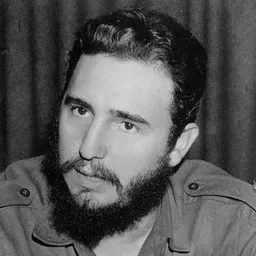
Fidel Castro
Leader of the Cuban Revolution and long-time head of Cuba · 1926–2016
Castro led the 1959 Cuban Revolution and governed Cuba as prime minister and then president until 2008. He built a one-party communist state allied with the Soviet Union and expanded public healthcare and education.
How close are you? Take the test →Position on the 12 axes
Estimated from their documented words and actions. A simplification, not a verdict.
He ran a highly centralised state from Havana with little regional autonomy.
He ruled for nearly five decades in a one-party state without competitive elections.
His government imprisoned dissidents, executed opponents after the revolution and restricted free speech and movement.
He sent Cuban troops and doctors abroad, including to Angola, as part of an internationalist foreign policy.
He led guerrilla war to take power, faced the Bay of Pigs invasion and deployed forces in African wars.
No strong recorded view on immigration; emigration from Cuba was tightly controlled.
He nationalised almost all land, industry and business, including foreign-owned property.
Cuba operated a Soviet-style planned economy under his rule, with only limited market reforms.
He kept foreign trade under state monopoly and relied on Soviet bloc trade.
Cuba was an officially atheist state until 1992, when he allowed believers to join the Communist Party.
He expanded literacy and women's rights, but gay men were sent to UMAP labour camps in the 1960s, which he later acknowledged as an injustice.
He invested in medical research and education but showed no particular commitment to technological acceleration.