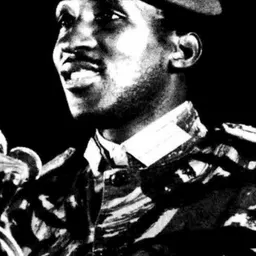
Thomas Sankara
President of Burkina Faso · 1949–1987
Sankara was an army captain who took power in Upper Volta in 1983, renamed it Burkina Faso and led it until his assassination in 1987. He pursued a Marxist, pan-Africanist programme of self-reliance, anti-corruption and social reform.
How close are you? Take the test →Position on the 12 axes
Estimated from their documented words and actions. A simplification, not a verdict.
He set up Committees for the Defence of the Revolution across the country but kept power in the National Council.
He came to power in a coup and did not hold multiparty elections.
The revolutionary committees and popular tribunals sometimes acted against opponents and trade unions.
He promoted pan-African solidarity and called for collective repudiation of foreign debt.
He was a military officer whose government fought a short border war with Mali in 1985.
No strong recorded view on immigration.
He redistributed land and pursued egalitarian, anti-corruption policies.
He organised the economy around state-led development plans.
He urged Burkinabè to "consume what we produce" and reduce reliance on imports.
He led a secular revolutionary government.
He banned female genital mutilation and forced marriage, and appointed women to government.
He promoted reforestation and mass vaccination, with an emphasis on ecological sustainability.