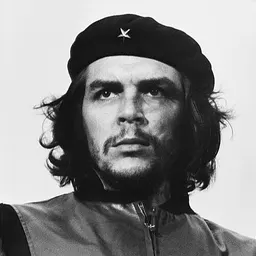
Che Guevara
Argentine-born Marxist revolutionary and Cuban minister · 1928–1967
Guevara was a guerrilla commander in the Cuban Revolution who then served as head of Cuba's national bank and minister of industries. He tried to spread armed revolution to the Congo and Bolivia, where he was captured and executed.
How close are you? Take the test →Position on the 12 axes
Estimated from their documented words and actions. A simplification, not a verdict.
He favoured a centralised revolutionary state and central control of industry.
He opposed liberal elections and argued for a vanguard-led revolutionary government.
He oversaw executions at La Cabaña prison after the revolution and set up the Guanahacabibes labour camp.
He called for "two, three, many Vietnams" and fought for revolution beyond Cuba in Africa and South America.
He wrote a manual on guerrilla warfare and believed armed struggle was the main path to revolution.
No strong recorded view on immigration or integration.
He sought to abolish private property and wanted moral rather than material incentives for work.
As minister he backed a centralised "budgetary finance system" over the more market-oriented Soviet model.
He tried to reduce Cuba's dependence on sugar exports through industrialisation and criticised unequal trade.
He was a Marxist atheist with no role for religion in his politics.
He described the goal of creating a "new man" free of selfishness, though he held conventional views on many social questions.
He pushed rapid industrialisation of Cuba as minister of industries.