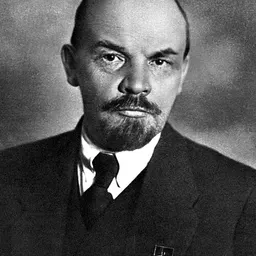
Vladimir Lenin
Leader of the Bolshevik Revolution and first head of Soviet Russia · 1870–1924
Lenin led the Bolshevik seizure of power in Russia in 1917 and headed the new Soviet state until his death. He argued for a disciplined vanguard party, the dictatorship of the proletariat and world socialist revolution.
How close are you? Take the test →Position on the 12 axes
Estimated from their documented words and actions. A simplification, not a verdict.
He built a centralised party under democratic centralism, though he backed a formal union of equal Soviet republics over Stalin's plan to absorb them into Russia.
He dissolved the elected Constituent Assembly in 1918, banned rival parties and, in 1921, factions within his own party.
He created the Cheka secret police and sanctioned the Red Terror against perceived class enemies during the Civil War.
He founded the Communist International in 1919 to spread revolution worldwide and saw the Russian revolution as one front of a global one.
He led the Bolsheviks through the Civil War with the Red Army, while also taking Russia out of the First World War at Brest-Litovsk.
He defended national self-determination and condemned "Great Russian chauvinism," supporting native-language administration in non-Russian regions.
He nationalised land, banks and large industry, aiming at the abolition of private ownership of the means of production.
He imposed War Communism, then retreated to the mixed New Economic Policy in 1921 while keeping the "commanding heights" under state control.
His government established a state monopoly on foreign trade, though he sought foreign concessions and capital under the NEP.
He was a militant atheist; his government separated church from state, seized church property and repressed clergy.
Early Soviet decrees under him legalised divorce, decriminalised homosexuality and declared legal equality for women.
He championed industrial modernisation, famously defining communism as "Soviet power plus the electrification of the whole country."