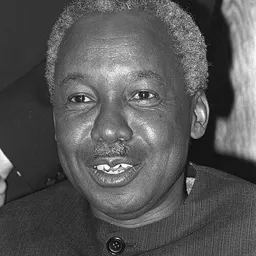
Julius Nyerere
1st President of Tanzania · 1922–1999
Julius Nyerere led Tanganyika to independence in 1961 and governed the united Tanzania until 1985. He promoted Ujamaa, a form of African socialism built on collective villages and self-reliance, within a one-party state.
How close are you? Take the test →Position on the 12 axes
Estimated from their documented words and actions. A simplification, not a verdict.
Abolished the powers of traditional chiefs and ran Tanzania as a centralized state, keeping Zanzibar's autonomy within a tightly controlled union.
Made TANU the sole legal party in 1965, though he allowed contested elections between party candidates and stepped down voluntarily in 1985.
Used the Preventive Detention Act of 1962 to hold political opponents without trial.
A leading Pan-Africanist who helped found the Organisation of African Unity and hosted southern African liberation movements.
Favoured non-alignment and diplomacy, but sent Tanzanian forces into Uganda in 1979 after Idi Amin's invasion, ending Amin's rule.
Built a single national identity around Swahili and discouraged tribal politics, while also accepting large numbers of refugees.
The Arusha Declaration of 1967 nationalized banks and major industries and set collective ownership as the national goal.
Directed the economy through state corporations and moved millions of rural people into planned Ujamaa villages.
Made self-reliance the core economic principle, aiming to reduce dependence on foreign capital and imports.
A devout Catholic who nonetheless kept the state formally neutral among Tanzania's Christian and Muslim communities.
Pushed racial and social equality and rural education, while grounding his socialism in an idealized view of traditional African community.
No strong recorded view on technology; his policy favoured rural self-reliance over heavy industrialization.