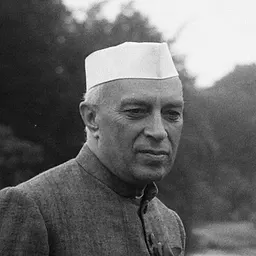
Jawaharlal Nehru
First Prime Minister of India · 1889–1964
Nehru was a leader of the Indian independence movement and served as India's first prime minister from 1947 to 1964. He built a parliamentary democracy, a secular state and a planned mixed economy, and co-founded the Non-Aligned Movement.
How close are you? Take the test →Position on the 12 axes
Estimated from their documented words and actions. A simplification, not a verdict.
He accepted a federal constitution with a strong centre and the reorganisation of states along linguistic lines.
He led India through regular free elections and parliamentary government.
He used preventive detention laws and dismissed Kerala's elected communist government in 1959, but generally upheld civil liberties.
He supported the United Nations and co-founded the Non-Aligned Movement.
He preferred diplomacy and non-alignment, though India took Goa by force in 1961.
He promoted a pluralist "unity in diversity" and opposed communal nationalism.
He favoured democratic socialism and a large public sector alongside private business.
He launched India's Five-Year Plans through the Planning Commission.
His government protected domestic industry through import substitution and licensing.
He was a firm secularist who opposed religious politics.
He pushed the Hindu Code Bills, giving women rights in marriage, divorce and inheritance.
He founded the IITs and India's atomic energy programme and called dams "temples of modern India."