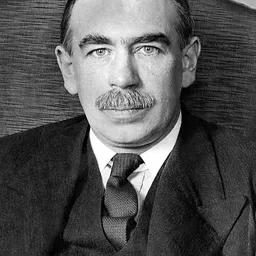
John Maynard Keynes
British economist · 1883–1946
John Maynard Keynes was a British economist whose General Theory argued that governments should manage overall demand to fight unemployment. He criticised the Treaty of Versailles and helped design the postwar Bretton Woods monetary system.
How close are you? Take the test →Position on the 12 axes
Estimated from their documented words and actions. A simplification, not a verdict.
No strong recorded view.
A Liberal who worked within parliamentary democracy and rejected both communism and fascism.
Defended personal liberty while accepting a larger state role in the economy.
Helped design the International Monetary Fund and World Bank at Bretton Woods.
Criticised the punitive Versailles peace, while serving the British war effort in both world wars.
No strong recorded view.
Supported reducing inequality but defended private enterprise and opposed socialism.
Argued governments should use spending and investment to stabilise employment.
Defended a revenue tariff in the early 1930s and wrote 'National Self-Sufficiency' in 1933.
A secular member of the Bloomsbury circle with little interest in religious authority.
Liberal on social questions for his era, though he served as a director of the Eugenics Society.
His essay on 'our grandchildren' predicted that technology would end economic scarcity.