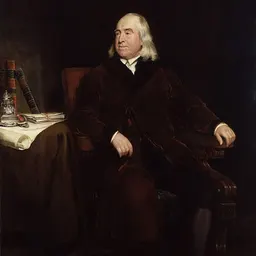
Jeremy Bentham
English philosopher and founder of utilitarianism · 1748–1832
Jeremy Bentham was an English philosopher and legal reformer who held that laws should aim at the greatest happiness of the greatest number. He campaigned for democratic reform, codified law and prison reform, and wrote early arguments for decriminalising homosexuality.
How close are you? Take the test →Position on the 12 axes
Estimated from their documented words and actions. A simplification, not a verdict.
His Constitutional Code designed a centralised, uniform administration accountable to a single legislature.
Argued for universal suffrage, annual parliaments and the secret ballot.
Mocked natural rights as 'nonsense upon stilts' and designed the Panopticon, while defending many personal liberties.
Coined the word 'international' and proposed a common court and plan for universal peace.
His peace plan called for reducing armed forces and freeing colonies.
No strong recorded view.
Saw more equal distribution as raising happiness, but put security of property first.
Generally favoured free markets while listing tasks for state action.
Opposed colonial trade monopolies and favoured freer trade.
Attacked established religion and wanted law based on utility, not theology.
Supported women's suffrage, decriminalising homosexuality and animal welfare, far ahead of his time.
Embraced invention and rational design, from prisons to legal codes.