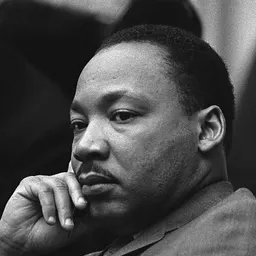
Martin Luther King Jr.
Baptist minister and civil rights leader · 1929–1968
King was the most prominent leader of the American civil rights movement, using nonviolent protest to challenge racial segregation and disenfranchisement. In his final years he broadened his focus to poverty and opposition to the Vietnam War.
How close are you? Take the test →Position on the 12 axes
Estimated from their documented words and actions. A simplification, not a verdict.
He pressed Washington to override segregationist state governments and criticised appeals to states' rights.
Securing voting rights for Black Americans, as in the Selma campaign, was one of his central goals.
He practised civil disobedience against unjust laws and was jailed many times, while accepting the legal penalties.
He spoke of a 'world house' and argued that injustice anywhere threatened justice everywhere.
He held to nonviolence and publicly opposed the Vietnam War in 1967.
He sought full integration of Black Americans as equals rather than cultural conformity; immigration was not a major theme.
He called for a redistribution of economic power and privately expressed sympathy for democratic socialism.
He advocated a guaranteed annual income and large federal anti-poverty programmes through the Poor People's Campaign.
No strong recorded view on trade policy.
His Christian faith framed his public arguments, though he supported the Supreme Court ruling against official school prayer.
He led the drive to dismantle legal segregation and extend civil and economic rights.
He warned that scientific and technical power had outrun moral progress, without opposing technology as such.