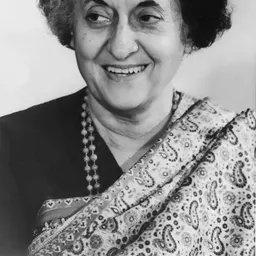
Indira Gandhi
3rd Prime Minister of India · 1917–1984
Indira Gandhi was prime minister of India from 1966 to 1977 and from 1980 until her assassination in 1984. She nationalized banks, led India in the 1971 war that produced Bangladesh, and declared a national Emergency from 1975 to 1977 that suspended civil liberties.
How close are you? Take the test →Position on the 12 axes
Estimated from their documented words and actions. A simplification, not a verdict.
Centralized power in the prime minister's office and frequently used President's Rule to dismiss opposition-led state governments.
Won national elections, but ruled by decree during the 1975–77 Emergency; she then called elections and accepted defeat in 1977.
During the Emergency she jailed opposition leaders, censored the press and suspended civil rights.
Followed non-alignment while signing a 1971 friendship treaty with the Soviet Union, and guarded Indian sovereignty closely.
Led India to victory in the 1971 war, approved the 1974 nuclear test and ordered the 1984 army assault on the Golden Temple.
Defended India's constitutional pluralism, though she took a hard line against regional separatist movements.
Campaigned on 'Garibi Hatao' (remove poverty), nationalized major banks and abolished the princes' privy purses.
Expanded state control of banking, insurance, coal and other industries under five-year plans and licensing.
Kept high tariffs and strict import controls to protect Indian industry.
The 42nd Amendment added the word 'secular' to the preamble of India's constitution in 1976.
Pursued socialist reforms and was India's first woman prime minister; the Emergency also included coercive sterilization drives.
Backed the Green Revolution, the nuclear programme and India's early space programme.