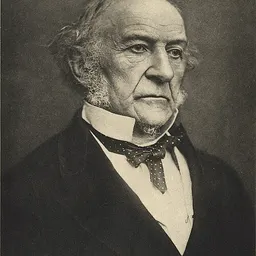
William Ewart Gladstone
Prime Minister of the United Kingdom · 1809–1898
Gladstone led the Liberal Party and served four times as prime minister between 1868 and 1894. He championed free trade, low public spending, electoral reform and Home Rule for Ireland.
How close are you? Take the test →Position on the 12 axes
Estimated from their documented words and actions. A simplification, not a verdict.
Twice introduced bills to give Ireland its own parliament through Home Rule.
Introduced the secret ballot and the Third Reform Act extending the vote to rural workers.
Defended civil liberties in principle but passed coercion acts in Ireland.
Favoured the Concert of Europe and international arbitration, as in the Alabama claims.
Criticised imperial wars and Ottoman atrocities, though his government occupied Egypt in 1882.
No strong recorded view on immigration.
A classical liberal who sought low taxes and balanced budgets.
Believed in minimal state spending and leaving money to fructify in the pockets of the people.
As Chancellor he removed most remaining tariffs, making Britain a free-trade economy.
A devout Anglican whose politics were shaped by faith, though he disestablished the Irish Church.
A reformer by 19th-century standards on suffrage and education, though he opposed votes for women.
No strong recorded view on technology; his Railway Act 1844 regulated rail fares.