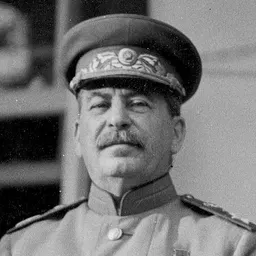
Joseph Stalin
General Secretary of the Communist Party of the Soviet Union · 1878–1953
Stalin rose to lead the Soviet Union after Lenin's death and ruled it until 1953. He pursued forced collectivisation, rapid industrialisation and mass political repression, and led the country through the Second World War.
How close are you? Take the test →Position on the 12 axes
Estimated from their documented words and actions. A simplification, not a verdict.
Although the USSR was formally a federation, he concentrated real power in Moscow and in his own hands.
He ruled as a personal dictator, eliminating rivals and holding single-candidate elections without real choice.
He directed the Great Purge and expanded the Gulag labour camp system, with millions arrested, deported or executed.
He promoted "socialism in one country," putting Soviet state interests ahead of world revolution and dissolving the Comintern in 1943.
He built up massive armed forces, led the war against Nazi Germany and expanded Soviet control over Eastern Europe.
He ordered the deportation of whole nationalities, such as Chechens and Crimean Tatars, and promoted Russian language and culture.
He abolished most private farming and trade through collectivisation and state ownership.
He introduced the Five-Year Plans, placing nearly all production and prices under central state planning.
He pursued economic self-sufficiency and kept the Soviet bloc largely separate from Western markets.
He waged anti-religious campaigns in the 1930s, though he allowed a limited revival of the Orthodox Church during the war.
He reversed several early Soviet reforms, recriminalising homosexuality and banning abortion in 1936, and promoted traditional family roles.
He prioritised heavy industry, electrification and science, including the Soviet atomic bomb project.