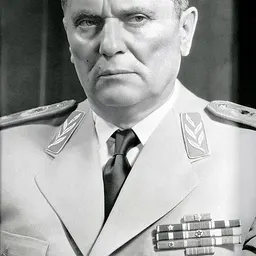
Josip Broz Tito
President of Yugoslavia · 1892–1980
Tito led the communist Partisans against Axis occupation in the Second World War and then ruled Yugoslavia until his death. He broke with Stalin in 1948, developed workers' self-management and co-founded the Non-Aligned Movement.
How close are you? Take the test →Position on the 12 axes
Estimated from their documented words and actions. A simplification, not a verdict.
He organised Yugoslavia as a federation of six republics, and the 1974 constitution gave them and two provinces wide powers.
He ruled as president for life in a one-party state.
His government imprisoned Stalin sympathisers on Goli Otok and suppressed nationalist and liberal dissent.
He co-founded the Non-Aligned Movement and kept Yugoslavia independent of both Cold War blocs.
He led Partisan guerrilla war and maintained a large army and territorial defence doctrine.
His slogan "brotherhood and unity" promoted coexistence of Yugoslavia's many nations while suppressing ethnic nationalism.
He promoted social ownership of enterprises run by workers' councils.
He moved away from Soviet central planning towards market socialism with self-managed firms.
Yugoslavia traded with both East and West, allowed citizens to work abroad and took Western loans.
The state was officially secular and restricted religious institutions, though less harshly than in the Soviet bloc.
His government promoted women's legal equality and secular education.
He backed industrialisation and modernisation of a largely rural country.