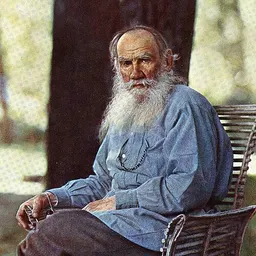
Leo Tolstoy
Novelist and Christian anarchist thinker · 1828–1910
Tolstoy was a Russian novelist, author of War and Peace and Anna Karenina, who in later life developed a radical Christian ethic of nonviolence. He rejected the state, the church and private land ownership, and was excommunicated by the Russian Orthodox Church.
How close are you? Take the test →Position on the 12 axes
Estimated from their documented words and actions. A simplification, not a verdict.
He rejected the state entirely in favour of voluntary moral communities.
He regarded all governments, elected ones included, as resting on violence and refused to participate in them.
He opposed courts, prisons, conscription and capital punishment.
He condemned patriotism as an outdated and harmful sentiment that led to war.
His doctrine of non-resistance to evil by force rejected all violence, including defensive war.
No strong recorded view on immigration; he defended persecuted minorities such as the Doukhobors.
He tried to give away his property and condemned private ownership of land.
He supported Henry George's single land tax but distrusted state management of the economy.
No strong recorded view on trade.
His politics came from his reading of the Gospels, though he rejected church doctrine and institutions.
He was radical on property and violence but socially conservative on sexuality and simple peasant life.
He idealised rural labour and criticised modern industrial civilisation.