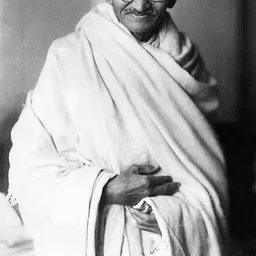
Mahatma Gandhi
Leader of the Indian independence movement · 1869–1948
Gandhi led India's campaign for independence from British rule through mass nonviolent resistance, which he called satyagraha. He argued for self-reliant village communities, religious harmony between Hindus and Muslims, and an end to untouchability.
How close are you? Take the test →Position on the 12 axes
Estimated from their documented words and actions. A simplification, not a verdict.
His ideal of village swaraj placed most authority in largely self-governing village republics rather than a central state.
He backed self-rule and mass participation in Congress politics, though he distrusted parliamentary politics and led largely by moral authority.
He deliberately broke laws he considered unjust, such as the salt tax, and accepted imprisonment as a form of protest.
He led a national independence struggle but framed it in universal ethical terms and rejected hatred of the British people.
Nonviolence was the centre of his politics; he urged nonviolent resistance even against invasion.
He insisted India belonged equally to Hindus, Muslims and other communities and opposed religious partition.
His trusteeship doctrine asked the rich to hold wealth for the common good, though he opposed forcible expropriation and class war.
He favoured small-scale, village-based production over both state planning and large capitalist industry.
He made swadeshi, the boycott of foreign cloth and home spinning, a central tool of the independence movement.
He described his politics as inseparable from religion and used Hindu concepts throughout public life, while respecting all faiths.
He campaigned against untouchability and drew women into politics, yet defended a reformed varna order and conservative sexual ethics.
In Hind Swaraj he condemned modern machinery and industrial civilisation as harmful to human well-being.