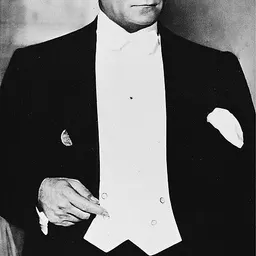
Mustafa Kemal Atatürk
Founder and first President of the Republic of Turkey · 1881–1938
Atatürk led the Turkish War of Independence and founded the Republic of Turkey in 1923, serving as its president until his death. He carried out sweeping secular and modernising reforms and built a Turkish national identity.
How close are you? Take the test →Position on the 12 axes
Estimated from their documented words and actions. A simplification, not a verdict.
He built a strongly centralised unitary state governed from Ankara.
He led a one-party state under the Republican People's Party, though he briefly allowed opposition parties in 1924 and 1930.
His government suppressed revolts and opposition under emergency laws.
His motto "Peace at home, peace in the world" put Turkish national sovereignty first without expansion.
He was a military commander who won the War of Independence, then pursued a peaceful foreign policy.
He promoted a single Turkish national identity and the use of Turkish by all citizens, including Kurds.
He combined state enterprises with private business under the principle of "étatism."
He launched étatism and Turkey's first Five-Year industrial plan in 1934.
He favoured state-protected domestic industry after the 1929 crash.
He abolished the caliphate and religious courts and made laïcité a constitutional principle.
He introduced the Latin alphabet, Western dress and law, and women's suffrage in 1934.
He saw science and modern technology as the path to "contemporary civilisation."