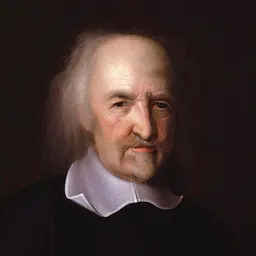
Thomas Hobbes
English philosopher, author of Leviathan · 1588–1679
Thomas Hobbes was an English philosopher who wrote Leviathan during the English Civil War. He argued that without a strong sovereign life would be a war of all against all, so people should accept an undivided, absolute authority in exchange for peace.
How close are you? Take the test →Position on the 12 axes
Estimated from their documented words and actions. A simplification, not a verdict.
Held that sovereign power must be undivided; splitting authority among bodies leads to civil war.
Grounded authority in a social contract but favoured absolute monarchy and denied a right to rebel.
Argued that security is the purpose of the state and subjects must accept broad limits on liberty to obtain it.
Saw states as remaining in a state of nature toward one another, with no authority above them.
Named seeking peace as the first law of nature, yet gave the sovereign full control of war and the militia.
No strong recorded view.
Held that property exists only by the sovereign's grant and that the state should provide for those unable to work.
Gave the sovereign authority to distribute property and regulate trade as public peace requires.
No strong recorded view.
Subordinated the church to the sovereign, who decides public worship; neither separation nor clerical rule.
No clear position; his theory broke with tradition but aimed at stability rather than social change.
Promoted a mechanical, scientific view of nature and tied arts and industry to the peace a sovereign provides.